Saturday, 30 July 2022

A couple proverbs | Un paio di proverbi

  1. La prima cosa è I cosi beđđi, proverbio siciliano tradotto a caso in un po' di lingue. Comincio citando quel che andrò a levare da Le traduzioni più ad minchiam di sempre | Most random translations ever, dove questa cosa appariva in origine appena prima del brindisi: «Nel frattempo però abbiamo il proverbio Siciliano "I cosi beddi s'hann'a talïari", che avevo tradotto in Italiano così a caso in un tempo non meglio precisabile, probabilmente poco dopo averlo beccato a caso in un commento su Facebook, comunque quasi sicuramente in tempi di blog, ma l'avevo ritenuta troppo una cavolata per segnarmela. Peccato, perché poi il 14/4/22 tra le 21:15 e le 21:20 decido di tradurlo anche in Cinese e Hakka, prima in 4 sillabe poi in 5, che conta come un emistichio e quindi va messo qui». L'ultima traduzione invece la recupero da IAFI, dove si dice semplicemente «21/7/22 1:24 I randomly do this.» (il 21/7/22 all'1:24 faccio a caso questa [traduzione]). E poi abbiamo il riempicolonna Spagnolo delle 15:54 del 30/7/22. Spagnolo fatto dopo aver fallito il Francese… che faccio poi andando a messa alle 16:15, sicché alle 16:20-16:24 (sempre il 30/7/22) tocca fare l'Albanese, che l'indomani alle 18:47 cambio da «Gjën' të bukura duhet t'i shikosh» alla versione sotto, ispirato da un post sul Cult of Linguists e dal descrivere al postatore le varie traduzioni in Albanese che ho fatto.
  2. La seconda cosa sta pure lei su IAFI, dove per il Francese si dice «21/7/22 between 1:02 and 1:16, after an English fail, I translate this proverb into French, and then finally do the English.» (Il 21/7/22 tra l'1:02 e l'1:16, dopo un tentativo fallito in English, traduco questo proverbio in Francese, e finalmente faccio l'Inglese), quindi abbiamo la storia delle due. Vediamo se ho qualche versione scartata… «The bed's like a rose: / <Who sleeps not, doth/will> repose» e «The bed's like a rose: / Those who don't sleep, repose», penso che una la uso come riempicolonna. Poi il 1/5/23 alle 14:37 faccio a caso lo Spagnolo, cambiando lecho in cama alle 19:50 del 5/5/23, vedendolo definito "più comune" (more common) sul Wiktionary. Nel frattempo ho fatto il Portoghese, ancora con leito invece di cama, ed è per quello che ho controllato cama per lo Spagnolo, e quindi anche in Portoghese lo cambio in cama, e poco dopo scopro che "reposa" è sbagliato e lo aggiusto. A proposito, ho ripiegato sul Portoghese dopo aver determinato che la rima in Albanese è semplicemente impossibile.
  3. Poi il 25/10/23 alle 19:07 ho in mente per caso "Chi è causa del suo mal pianga se stesso", e lo rendo in inglese con due tripodie giambiche.
  1. The first thing is "I cosi beđđi", a Sicilian proverb randomly translated into a few languages. I start by quoting what I'm going to remove from Le traduzioni più ad minchiam di sempre | Most random translations ever, where this thing originally appeared just before the toast: «In the meantime though we have the Sicilian proverb "I cosi beddi s'hann'a talïari", which I had translated to Italian very randomly in a time that I cannot better specify, probably shortly after finding it randomly in a Facebook comment, anyway almost certainly in blog times, but I had held it to be too BS to write it down. Which is a pity, because then on 14/4/22 between 21:15 and 21:20 I decide to translate it to Chinese and Hakka as well, first with 4 syllables then with 5, which makes it count as a hemistich (half-line) so I must put it here.». The last translation I recover instead from IAFI, where it simply says «21/7/22 1:24 I randomly do this.». And then we have the Spanish column-filler from 15:54 on 30/7/22, which I made after failing at the French… which I then manage while going to Mass at 16:15, so that 16:20-16:24 I gotta do the Albanian. Always on 30/7/22.
  2. The second thing is also on IAFI, where for the French it says «21/7/22 between 1:02 and 1:16, after an English fail, I translate this proverb into French, and then finally do the English.», so we have the history of the two. Let's see if I have some discarded versions… «The bed's like a rose: / <Who sleeps not, doth/will> repose» and «The bed's like a rose: / Those who don't sleep, repose», I think I'll use one as a column-filler. Then on 1/5/23 at 14:37 I randomly make the Spanish, changing lecho to cama at 19:50 on 5/5/23, seeing it termed as more common on Wiktionary. In the meantime I've made the Portuguese, again with leito which is why I checked cama, and changed it to cama, and slightly after that I find out "reposa" is incorrect and fix it. By the way, I fell back on Portuguese after determining that the rhyme in Albanian is simply impossible.
  3. Then on 25/10/23 at 19:07 I randomly have "Chi è causa del suo mal pianga se stesso" in mind, and I render it as two iambic tripodies in English.
I cosi beđđi s'hann'a talïari

美事人该看

靓事人爱看

Beautiful thing sure should be gazed upon.

Les chosės belles, elles s'ont/sont à regarder.


Il letto è una rosa:
Chi non dorme, riposa.

For beds are like roses:
Who sleeps not, reposes.

La cama es una rosa:
Quien no duerme, reposa.


Chi è causa del suo mal, pianga se stesso.

Le cose belle s'hanno da guardare

Měi shì rén gāi kàn

Tsiang sìi nyîn òi khòn

Se tiene que mirar lo que es hermoso.

Gjërat t' bukura duhet t'i shikosh.


Le lit c'est une rose:
Qui dort pas, il répose.

The bed's like a rose:
Those who don't sleep, repose.

A cama é uma rosa:
Quem não dorme, repousa.


May he becry himself
Who's cause of his own ill.

Tuesday, 5 July 2022

La mamma mi diceva

Oggi abbiamo una canzone italiana, La mamma mi diceva. E perché diamine me so' mmesso a tradurla in greco, 'sta stupidata? Beh, lascio rispondere il post delle incompiute: "As we travel back from L'Aquila to Carate on 23/6/22, dad pulls this gem out of the blue (well, he actually starts with this one and then gets to the one of interest by tune similarity). I start thinking of an English version, something like «Long live love», but I don't even bother to mark it down because it's just a random divertissement, not really a translation. I then think of Greek, probably expecting a better tune fit, and think, hmm, eros or agapi? I'm thinking of Quoraing when I look at the end of the chorus, and am like Yep, that's eros. OK, so then I end up translating the chorus as «Να ζει ο έρως, ο έρως, / Που έρχεται και πάει! […] Να ζει ο έρως, / Να ζει ο έρως / Κι αυτοί που τον κάνουν» at 21:57 and, after considering a singularisation of that aytoí which doesn't convince me, I do l. 1 of the verses as «Μου έλεγ' η μαμά μου», and now I'm in this. I think back to it at 22:57 and 22:58 to produce the versions below of the ending, resp. the left versions and the right ones" (Mentre torniamo da L'Aquila a Carate il 23/6/22, il babbo tira fuori dal nulla questa gemma (beh, in realtà parte con questa e poi arriva a quella che ci interessa per somiglianza di melodia). Inizio a pensare ad una versione inglese, una roba tipo «Long live love», ma manco mi disturbo a scriverla giù perché è solo un divertissement ad minchiam, non proprio una traduzione. Poi penso al Greco, probabilmente aspettandomi che stia meglio nella melodia, e penso, hmm, eros o agapi? Sto pensando di rivolgermi a Quora quando guardo la fine del ritornello e sono tipo Sì, è eros. OK, allora finisco per tradurre il ritornello come «Να ζει ο έρως, ο έρως, / Που έρχεται και πάει! […] Να ζει ο έρως, / Να ζει ο έρως / Κι αυτοί που τον κάνουν» alle 21:57 e, dopo aver considerato una singularizzazione di quell'aytoí che non mi convince, faccio la riga 1 delle strofe come «Μου έλεγ' η μαμά μου», e mo' ci son dentro. Ci ripenso alle 22:57 e alle 22:58 producendo le versioni sotto della fine, risp. [la versione «Ο έρως με αυτούς / Που τον κάνουνε» e la versione «Να ζουν αυτοί / Που τον κάνου καλά!», che poi ho finito per adottare]). Dopodiché l'1/7/22 faccio intervenire la miti-Kika, per cui mi metto a tradurre le strofe alle 18:01, ora delle 18:18 ne ho due e mezza (biondi mori e mezzi castani), e alle 18:51 le ho tutte, salvo poi che discutiamo sui castani, arrivando a quattro versioni del "Ché son tutti barbagiani", che uso tutte e 4 nella versione greca sotto, che è quella mandata a Kika alle 19:57 del 2/7/22. Bon, vediamola! Sapete che vi dico? A 'sto giro, niente traslitterazione, non ci ho voglia di perderci N tempo per poi lasciare una colonna da riempire :). Fra l'altro con questa ho scoperto un interessante false friend greco-italiano: trombáro vuol dire "mi masturbo".


La mamma mi diceva:
«Non prendere dei biondi,
Ché son tutti vagabondi,
Ché son tutti vagabondi».
La mamma mi diceva:
«Non prendere dei biondi,
Ché son tutti vagabondi
E l'amor non sanno far!
Ché son tutti vagabondi
E l'amor non sanno far!».

Rit.:
Viva l'amore, l'amore,
L'amor che vien, che va,
Viva l'amore, l'amore,
L'amor che vien, che va,
Viva l'amore, l'amore,
L'amor che vien, che va,
Viva l'amor, viva l'amor,
E chi lo sa far!

La mamma mi diceva:
«Non prendere dei mori,
Ché son tutti traditori,
Ché son tutti traditori».
La mamma mi diceva:
«Non prendere dei mori,
Ché son tutti traditori
E l'amor non sanno far!
Ché son tutti traditori
E l'amor non sanno far!».

Rit.

La mamma mi diceva:
«Non prendere i castani,
Ché son tutti barbagiani,
Ché son tutti barbagiani».
La mamma mi diceva:
«Non prendere castani,
Ché son tutti barbagiani
E l'amor non sanno far!
Ché son tutti barbagiani
E l'amor non sanno far!».

Rit.

La mamma mi diceva:
«Non prendere dei rossi,
Ché son tutti saltafossi,
Ché son tutti saltafossi».
La mamma mi diceva:
«Non prendere dei rossi,
Ché son tutti saltafossi
E l'amor non sanno far!
Ché son tutti saltafossi
E l'amor non sanno far!».

Rit.
Μου έλεγ' η μαμά μου·
«Μην παντρεύεσαι ξανθομάλλη,
Όλοι μόνο είναι γάλοι,
Όλοι μόνο είναι γάλοι».
Μου έλεγ' η μαμά μου·
«Μην παντρεύεσαι ξανθομάλλη,
Όλοι μόνο είναι γάλοι,
Δεν γνωρίζουν τον έρωτα!
Όλοι μόνο είναι γάλοι,
Δεν γνωρίζουν τον έρωτα!»

Επωδός·
Να ζει ο έρως, ο έρως
Που έρχεται και πάει,
Να ζει ο έρως, ο έρως
Που έρχεται και πάει,
Να ζει ο έρως, ο έρως
Που έρχεται και πάει,
Να ζει ο έρως, να ζουν αυτοί
Που τον κάνουν καλά!

Μου έλεγ' η μαμά μου·
«Μην παντρεύεσαι μαυρομάλλη,
Όλοι μόνο είναι λάλοι,
Όλοι μόνο είναι λάλοι».
Μου έλεγ' η μαμά μου·
«Μην παντρεύεσαι μαυρομάλλη,
Όλοι μόνο είναι λάλοι,
Δεν γνωρίζουν τον έρωτα!
Όλοι μόνο είναι λάλοι,
Δεν γνωρίζουν τον έρωτα!»

Επωδ.

Μου έλεγ' η μαμά μου·
«Μην παντρεύεσ' έναν καστάνο,
Αυτοί να μην σε γλυκάνουν,
Όλοι 'ν' άδειοι εκεί κάτω!».
Μου έλεγ' η μαμά μου·
«Μην παντρεύεσ' έναν καστάνο,
Τίποτα δεν κρύβουν κάτω,
Δεν γνωρίζουν τον έρωτα!
Τα μαλλιά μόν' έχουν πάνω,
Δεν γνωρίζουν τον έρωτα!»

Επωδ.

Μου έλεγ' η μαμά μου·
«Κόκκινος άντρας μην σε πάρει
Μόνο ξέρει να τρομπάρει,
Μόνο ξέρει να τρομπάρει».
Μου έλεγ' η μαμά μου·
«Κόκκινος άντρας μην σε πάρει
Μόνο ξέρει να τρομπάρει,
Δεν γνωρίζει τον έρωτα!
Μόνο ξέρει να τρομπάρει,
Δεν γνωρίζει τον έρωτα!»

Επωδ.

Saturday, 14 May 2022

C'est la vie

You thought this was a French post, huh? Well, nope! English. Today we have a Greek song, Έτσ' είν' η ζωή | Éts' ë́n' i̱ zōí̱, "Life is like that", translated:
  1. To French, for which I quote the intro in the Incomplete translations post: «Because of an idea of a tweak (which I will soon implement here), I ask this question. On 2/2/22, Nick Nicholas answers, and in the comments, Evangelos Lolos suggests a song reference: Έτσι είν' η ζωή. I listen to both that one and the song in the answer, but it is the former than I then start to translate at 17:57. First two lines of chorus then, last two at 18:05, rest of chorus and first mini-section at 18:40-18:47», and then this stays incomplete for ages until, at 2:42-2:50 on 11/5/22, I finally complete it; pretty sure the "Je te veux donner" is wrong though, so I fix it to "Je veux te donner" at 12:30 on 12/5/22, as I draft this post; by analogy, at 15:17 on 14/5/22, «Je me veux perdre» changes to the below form;
  2. To Italian: «As the French is coming along, at 18:02 I translate the first mini-section into Italian. I then do the chorus at 18:56-19:04. Then in the evening of 4/2/22 (well, more like in the night between then and 5/2/22), I get to bed at about 0:30, and feel it's too early to sleep, so I first complete the remake here, and then, 0:56-1:01, I complete this translation», which then proceeds to stay for ages in the incomplete translations post because I want to post this post when all translations are complete; «Dissi "Ch'io mi perda / E non torni indietro!"» takes its current form 11:59 28/6/22;
  3. To English: «As the other two are lying around, I translate the same parts into English 18:53-18:55, so as to reply to the comment with the song with them. That's where we're at for now. Apart from moving from "erasèd" to "unwritten" at 0:44 that night. Then 28/2/22 1:09 I make the second short section. Not too satisfied with that, IIRC. May tweak it or remake it. We'll see», and I do remake it, and I think the first one too; it happens on 11/5/22 at 2:14-2:41, so I do the English and then go straight to the French, and I have a whole slew of versions of the mini sections which I will include all below; while recording the English and Albanian versions on 7/6/22, at 12:18, I come up with 2E, which I record; 8/7/22 11:09, inspired by I don't remember what, I consider «That's just life, you know,», but I still prefer the below version;
  4. To Albanian: «And to fill the column in the post, at 21:46 on 3/2/22, I start the Albanian, doing only two lines of the chorus. I change ashtu to kështu at 19:28 on 5/2/22, upon placing this here. Already on 5/2 I change the first line of the chorus to "Jeta është k'shtu" and try to complete the chorus, getting stuck at "unwritten", for which I end up with "me e zhshkru". I also think about using "don me e ndryshu" and "don me e zhshkru". I ask Quora about zhshkru, and get told on 8/2 it's actually çshkru, so that's it. That day around 17 I complete the chorus and do the first section, and around 1:10 the following night I do the other section with the same tune. The "post-rit." of the Italian version [aka the post-chorus] gets made on 11-12/2/22, the first two lines in the morning around 10:20, and the rest 0:30-1:20, with a tweak to avoid the extra unwanted un's of «Po, njëher' dhe un' / Desha me ik' un', / Nga mallet e mi / Me mujt me ik un'» the next morning», and this too stays forever in that limbo of the Incomplete translations; since Google reads këtë as stressed on the kë, I figured maybe eliding that wasn't possible, so on 17/6/22 at 20:15 I thought of «kët' kërkoj», then at 20:38 of «k'shtu kërkoj», but I'm pretty sure Forvo is pronouncing it as stressed on the të, so ignore this change;
  5. Finally, to Spanish: «Around 8:35 on 19/3/22, on the wave of working a bit on 'O surdato 'nnammurato Spanish, I translate most of the chorus of this song to Spanish, leaving the two lines «Siempre hay quien rie / Y quien tiene que llorar.» unmade for want of rhyme, and dealing with them later at 18:38»; the wave was also inspired by hearing a couple Spanish versions of Italian songs at my friend's wedding in Villanueva de la Cañada; on 12/5/22 at 2:57-3:19, I complete this; then we have a "Flora 40 fix"; so, «Alma>corazón» is what she commented on the Spanish version on LT on 2/8/22 at 13:08; at 14:18, I replied «True, but corazón doesn't fit. And I feel like translating "hear" with "soul" when it means "seat of emotions" is within the limits of what can be justified by needing to fit a tune :); in the meantime, I thought «Maybe "contigo el corazón guárdate", either as con-ti-goel co¯ra¯zón¯ guáar-daa-te or con-ti-goel co-ra-zóon guár-da-te» at 14:28, and eventually settled for «Also, maybe "contigo el alma" at 14:29;
  6. Well, not finally; that qualification goes, for now, to the Romanian version; the incomplete translations post currently says «Since the new Romanian GSSI GH porter arrived, I've been thinking of taking Romanian back up, and today, 14/6/22, at 19:38 I finally translated l. 1 of this song as «Chiar eu odată». I will come back to this soon, I had to abandon it because I was making this huge update of this post.»; the very next night, 15/6, at 0:29-1:07 with two tweaks around 1:20, I get chorus, verse 1, and half of verse 2 done; next morning at 10:32-10:37 I touch up the «Vream să rătăcesc / Permanent atunci, vai!»; on 17/6 at 16:32 I make line 1 of the post-chorus at 18:59-19:24 I complete the thing; I still am in doubt, despite the aforementioned porter approving this translation wholeheartedly, whether to use Me-ntorsei or M-întorsei, Vream or Voiam, and țin-o or iei-o, thought I believe I always chose the former options in the recording I sent her which is probably what she approved.
I would technically need a column filler but I'm not sure what language to choose. Maybe one day I will do Portuguese. Anyway, let's see this!


Μια φορά κι εγώ
Κοίταξα πίσω,
Είπα να χαθώ
Να μη γυρίσω.

[Επωδός]
Έτσ' είν’ η ζωή,
Και πώς να την αλλάξεις;
Άλλοι κλαίνε κι άλλοι
Γελάνε δηλαδή.
Έτσ' είν’ η ζωή,
Και πώς να την ξεγράψεις;
Πώς να την ξεγράψεις
Με μολύβι και χαρτί;

[Μετεπωδός]
Κράτα μου το χέρι,
Κράτα το παράπονό μου,
Κράτα την καρδιά σου
Ώσπου να 'ρθει το πρωί·
Και να θυμηθείς,
Πριν φύγεις, να σου δώσω
Κόκκινο γαρίφαλο
Κι ένα γλυκό φιλί.
Και να θυμηθείς,
Πριν φύγεις, να σου δώσω
Κόκκινο γαρίφαλο
Κι ένα γλυκό φιλί.

Μια φορά κι εγώ
Είπα να φύγω,
Από τους καημούς
Για να ξεφύγω.

[Επωδός]

[Μετεπωδός]


Une foi moi aussi
J'regardais en arrière,
"Sans retour", je dis,
"Je veux me perdre!"

[Refrain]
La vie est ainsi,
Comment peut-on la changer?
Il y a ceux qui pleurent,
Et ceux qui rient peuvent pas manquer.
La vie est ainsi,
Comment peut-on l'effacer?
Oui, comment l'effacer
Avec crayon et papier?

[Après-refrain]
Tiens-moi donc la main,
Ah tiens-moi tout ce grand douleur-ci,
Et jusqu'au matin,
Ton cœur ne me veuilles pas donner.
Et avant d'aller
N'oublies pas, je t'en prie, que
Je veux te donner
Un œillet rouge et un doux baiser.
Et avant d'aller
N'oublies pas, je t'en prie, que
Je veux te donner
Un œillet rouge et un doux baiser.

Une fois moi aussi
Je m'voulais enfuir,
De tous mes désirs
Je m'voulais enfuir.

[Ref]

[Après-ref.
Once upon a time,
I also looked back,
Wanted to get lost
And never come back.
At one point I too
Looked o'er my shoulder,
Wanted to get lost
And come/go back no more
At one point I too
Looked o'er my backpack,
Wanted to get lost
And never come/go back
At one point I too
Looked o'er my backpack,
"Let's get lost in black
And come back no more!"
Once I too looked back
Over my shoulder:
"I'll step off the track
And go back no more"

[Chorus]
That's how life goes on,
How can you ever change it?
Some are crying, others
Are laughing certainly.
That's how life goes on,
And how can you erase it?
With but pen and paper
How can it unwritten be?

[Post-chorus]
Keep on holding my hand,
Keep my pains and griefs all with you,
Hold onto your heart
Until day comes for you and me.
And do not forget:
Before you leave, I want to
Give a red carnation
And a sweet sweet kiss to thee.
And do not forget:
Before you leave, I want to
Give a red carnation
And a sweet sweet kiss to thee.
At one point I too
Wanted to leave it
From my longings all
I dreamt of fleeing
At one point I too
To leave was hoping,
All my longings I
Dreamt of escaping.
Yes, at one point I
Considered leaving,
My ev'ry desire
I dreamt of escaping.
Yes, at one point I
To leave was hoping,
My ev'ry desire
I dreamt of escaping.
Yes, at one point I
Thought about leaving,
My ev'ry desire
I dreamt of escaping.

[Chorus]

[Post-Chorus]


Una vez yo también
Atrás he mirado,
Me quería perder
Y no ser reencontrado

[Estribillo]
La vida es así,
¿Cómo vas a mudarla?
Siempre hay quien ríe
Y quien tiene que llorar.
La vida es así,
¿Cómo vas a borrarla?
Con papel y lápiz
¿Cómo la vas a borrar?

[Post-estr.]
Toma tú mi mano,
Toma también mi gran pena
Hasta la mañana
Contigo el alma guárdate.
Y recuérdate:
Antes de que te vayas,
Un besito dulce
Y un clavel rojo te daré.
Y recuérdate:
Antes de que te vayas,
Un besito dulce
Y un clavel rojo te daré.

Una vez yo también
Quería huirme
De penas y deseos
Quería huirme

[Estr.]

[Post-estr.]
Mia forá ki egṓ
Kö́taxa písō,
Ë́pa na khathṓ
Na mi̱ gyrísō.

[Epōdós]
Éts' ë́n' i̱ zōí̱,
Kä pṓs na ti̱n alláxës?
Állö klä́ne ki állö
Geláne di̱ladí̱.
Éts' ë́n' i̱ zōí̱,
Kä pṓs na ti̱n xegrápsës?
Pṓs na ti̱n xegrápsës
Me molývi kä khartí?

[Metepōdós]
Kráta moy to khéri,
Kráta to paráponó moy,
Kráta ti̱n kardiá soy
Ṓspoy na 'rthë to prōí;
Kä na thymi̱thë́s,
Prin fýgës, na soy dṓsō
Kókkino garýfalo
Ki éna glykó filí.
Kä na thymi̱thë́s,
Prin fýgës, na soy dṓsō
Kókkino garýfalo
Ki éna glykó filí.

Mia forá ki egṓ
Ë́pa na fýgō,
Apó toys kai̱moýs
Gia na xefýgō.

[Epōdós]

[Metepōdós]


Una volta anch'io
Mi guardai dietro:
"Ch'io mi perda e più
Non torni indietro!"

[Rit.]
La vita è così,
E come puoi cambiarla?
C'è chi piange, e chi
Ride, no, non può mancar.
La vita è così,
Come puoi cancellarla?
Con matita e carta
Come la puoi cancellar?

[Post-Rit.]
Prendimi la mano,
Prendi, prendi il mio lamento,
Tienti stretto il cuore
Finché l'alba non verrà,
E non ti scordar
Che, prima che tu vada,
Dolci baci ed un rosso
Garofano ti vo' dar.
E non ti scordar
Che, prima che tu vada,
Dolci baci ed un rosso
Garofano ti vo' dar.

Una volta anch'io
Volevo andare,
Alle pene mie
Per scappare

[Rit.]

[Post-Rit.]


Po, njëher’ dhe un’
Pas meje shikova,
«T' humbas për gjithmon'!»,
Kështu mendova.

[Refreni]
Jeta ësthë k’shtu
Si don me e ndryshu ti?
Disa kon' me kja
Dhe disa kon' me qesh, them k'shtu.
Jeta ësthë k’shtu
Dhe si don me e çshkru ti?
Veç me laps dhe kārtë
Ti si do me e çshkru?

[Post-refreni]
Dorën merr-ëm, zemër,
Dhe ankesën time, merr-e,
Derisa vjen mëngjese
Zemrën tënde maj, o, maj!
Edhe kujto,
Para se t' ik, du me t' dhon' ty
Karafil t' kuq
Dhe një puthje t' ëmbël, k'të t' kërkoj!
Edhe kujto,
Para se t' ik, du me t' dhon' ty
Karafil t' kuq
Dhe një puthje t' ëmbël, k'të t' kërkoj!


Po, njëher' dhe un'
Desha t' largohem,
Nga mallet e mi
T' mund të largohem.

[Refreni]

[Post-refreni]


Odată chiar eu
Me-ntorsei și uitai,
Vream să rătăcesc
Și nu revin, vai!

[Refren]
Viața este așa,
S-o schimbi ti cum poți?
Unii sunt în fericirea,
Alții în chichionul.
Viața este așa,
S-o ștergi ti cum poți?
Da, cum poți s-o ștergi
Cu hârtia și creionul?

[După-refren]
Mâna ma acum ține,
Și doleanța mea, hai, țin-o
Și până la zori, hai,
Ține, ține inima ta!
Și să ti-amintești
Să-ti dau, înainte să pleci,
O garoafă roșă
Și un pupic dulce, o viața mea!
Și să ti-amintești
Să-ti dau, înainte să pleci,
O garoafă roșă
Și un pupic dulce, o viața mea!

Odată chiar eu
Da, să fug voiam,
De dorințele
Să pot să fug voiam

[Refren]

[După-refren]

Saturday, 30 April 2022

Un bacio a mezzanotte

Sicuramente già dal titolo saprete tutti che canzone abbiamo oggi. Ben, e in che lingua l'ho tradotta? Spagnolo. Così, a caso, perché ci avevo voglia. La parte delle donne, 21/4/22 16:00-16:13. L'altra parte, 29/4/22, primi quattro versi 10:26, il resto 20:23-20:31, con una modifichetta (Como podré no dejarme tentar -> Como puedo no dejarme tentar) il 30/4/22, cioè oggi che posto, alle 11/11:30. Notare questa domanda su Quora e poi l'alternativa «Luna, luna, tú / ¡No mires en mi! / Luna, luna, tú / ¡No curioses aquí» pensata alle 20:47. Altre opzioni per la riga 6 sono «Enamorarte siempre te hacerá» (1/5/22 3:19)e «Enamorarte siempre te dejará» (stessa notte 3:20). 3/5/22 0:05 cambio "para soñar" nella forma sotto per ragioni musicali. Da ultimo il 5/5 di notte mi rendo conto che «Que tu confianza / En las estrellas no derroches» ha un'ambiguità di divisione, e quindi scambio "tu confianza" con "las estrellas" alle 4:10 [e rifaccio la cosa alle 3:45 del 30/11/24, mentre lavo i denti]. Il 29/5/22 alle 19:49 penso a «No te vuelvas centinela», e quella notte all'1:54 arrivo alla versione sotto, da un originario «Que no seas centinela». Vediamola!


Non ti fidar
Di un bacio a mezzanotte,
Se c'è la luna non ti fidar,
Perché, perché
La luna a mezzanotte
Riesce sempre a farti innamorar!
Non ti fidar
Di stelle galeotte
Che invitano a volersi amar!
Mezzanotte per amar,
Mezzanotte per sognar,
Fantasticar!

Ma come farò
Senza più amar?
Ma come farò
Senza baciar?
Ma come farò
A non farmi tentar?
Luna, luna, tu
Non mi guardar!
Luna, luna, tu
Non curiosar!
Luna, luna, tu
Non far la sentinella!
Ogni stella in ciel
Parla al mio cuor,
Ogni stella in ciel
Parla d'amor,
Ogni stella in ciel
Sarà la mia stella
Mezzanotte per amar,
Mezzanotte per sognar,
Fantasticar!

[Parti sovrapposte]
Que no te fies
De un beso a medianoche,
Que no te fies si la luna está,
Porque, porque
La luna a medianoche
Enamorarte siempre logrará!
Que en las estrellas
Tu confianza no derroches:
Te envidan a querer amar!
Medianoche para amar,
Medianoche pa' soñar,
Fantasear!

¿Cómo voy a hacer
Sin más amar?
¿Cómo voy a hacer
Sin más besar?
¿Cómo puedo
No dejarme tentar?
Luna, luna, tú
¡No quieras mirar!
Luna, luna, tú
¡No quieras curiosear!
Luna, luna, tú
¡No hagas la centinela!
Cada estrella aquí
Habla de amor
Cada estrella aquí
Habla a mi corazón
Cada estrella aquí
Va a ser mi estrella!
Medianoche para amar,
Medianoche para soñar,
Fantasear!

[Partes sobrepuestas]

Tuesday, 22 March 2022

Pepito di Mallorca

As I was wheeled through Madrid, a solution to my walking problem, I randomly remembered this Italian song used for a game (with a somewhat different tune IIRC) back in my daycare time, and randomly translate it to Spanish, then French, then English, all between 11:41 and 12:37 of 13/3/22, but of course that took way less than that, just it wasn't all in one go. Anyway, here come the translations.


Oh Pepito, Pepito di Maiorca,
Aprimi la porta, aprimi la porta.
Oh Pepito, Pepito di Maiorca,
Aprimi la porta e dài un bacio a me, a me!


Oh Pepito, Pepito de Mallorca,
Ouvre-moi la porte, ouvre-moi la porte.
Oh Pepito, Pepito de Mallorca,
Ouvre-moi la porte et donne-moi un bisou, bisou!
Oh Pepito, Pepito de Mallorca,
Ábreme la puerta, ábreme la puerta.
Oh Pepito, Pepito de Mallorca,
Ábreme la puerta y deme un beso a mi, a mi!


Oh Pepito, Pepito of Mallorca,
Open up the door now, open up the door now.
Oh Pepito, Pepito of Mallorca,
Open up the door now and give a kiss to me, to me!

Monday, 21 February 2022

A few little songs of mine

With all the digging-in-the-past I've been doing lately for the chronological index, it is only fitting that remember of the very first few songs I wrote, one of which is also the oldest musical translation I ever made. Let me list these songs, give an idea of when I wrote them (they're so old I wasn't dating even my poems, and musical translations, save for that one song, didn't exist yet), and of when I translated them (all but one of them will have precise translation dates).
  1. The very first one is a very short song, with the tune stolen from a nursery rhyme brought home by my brother (much like The Disco beat) from school in England, called "I like chicken", which I am unable to find on the internet;
    I titled it "I love"; I wrote it for my crush in my first year of middle school (we're talking 2004-2005 here, it's aaaaaages ago); the text tells me it was past my birthday, 24/3/05, because I remember that day was when I realized looking at her sped up my heartbeat, hence I was in love; [well, there's a bit of confusion about this date; a poem from 2010 says this stadium thing was on 24/3/05, but then the commentary to this song says it was somewhere in March, and that on 24/3 I actually left Italy to go to England, so it was before 24/3; now, I do remember setting of on 24/3 in one year, but I think it was actually far earlier, specifically 2001-2002, my third year of primary, so… Idk;] the "I grew to like her" was in full force before the Xmas holidays, I remember another classmate asking me about it and then reporting it to my crush as we were bidding goodbyes; so, even assuming I was confident enough it was love before that 24/3, the song was definitely written after the holidays of 2004-2005; the crush ended (with)in July 2006, so that's the timeframe; [I could be more specific by figuring out when the school party for 2005-2006 was, since a poem of mine from High School says that, at that party, I figured out my crush was over; in fact, the commentary to this song, besides casting doubt on that 24/3 date as per above, also says I remembered composing it at the Italian school, which would put it before 24/3;]
    as for the translation, that one dates to 10/2/22 at 3:07; yeah, AM; kinda restless I was, I guess;
  2. The second one was for the next crush, which started in July 2006 and ended in June/July 2007, when the next one started;
    that is literally all I know about it; I cannot even find files with the song from that time, I apparently only ever wrote it down when I gathered my poems all the way into the Xmas holidays of 2009-2010 (and forgot about the next song, btw, only adding it to the collection way later); I don't even know if I wrote the tune or the words first, or even for sure if I started from the English or the Italian; I have a strong feeling that the English was original, but am not 100%;
    anyway, yeah, the translation is from that time too, and so is the tune;
    you may wonder how I know it was for this crush and not another one, since the text doesn't name her; well, I had a ringtone, on one of those old-ass mobiles where you could basically program a tune as a ringtone, which was the tune of this song, and was titled "Für Alena" (my mobile was in German, so the German title fit better :) );
    oh wait, the Latin history of my poems has something to say: «Hoc carmen composui in lecto cum eius musica inter Natalem anni MMVI et Kal.Ian. anni MMVII. Huius verba difficiliter memini et, ubi <> posui, cum deberem recomponere verba quæ memoriam reliquerant, probabillimum est me aliquid mutasse. Ob amorem Alenæ composui hoc carmen, quod titulum habet “Für Alena”» (I composed this song in bed with its music between Xmas 2006 and 1/1 2007. I recalled its lyrics with difficulty and, where I placed <>, having to recompose words that had left my memory, it is very likely that I changed something. For the love of Alena I composed this poem, which bears the title "Für Alena"»;
  3. Then we have this song, put into the tune of "The Bare Necessities"… in what year? Well, I don't know; the next crush was the longest of all, lasting from summer 2007 all the way to September 2009; I'm pretty sure the text is from one of those summers, but they're still three, and I have no idea which one I wrote it in; I wish I could place it; I'd assume it was before the other poems for this crush, since many of them go back to this theme of "I leave my thoughts free and you get into them";
    as per what the Incomplete translations post will soon no longer have, «In the dead of night of 10/2/22, I'm thinking of my old mini-songs, and I randomly decide to translate this one into Italian, possibly because the very title is inspired by «Del mïo pensiero tu sei regina» from Aida. […] Anyway, the current form of l. 3 is from 11/2 0:20, while that of l. 5 is from 10/2 12:19»;
  4. Finally, we have something I wrote down at the time of composition; it's titled "My love for you", I musicated it too, and I wrote it back in November-December 2007 (I remember singing it as I left the Open Day of my school in HS1);
    I have a file created 26/11/07 13:24 which contains the whole text save for the section «And another question, love, / Why did you at the end of our / Third year together vanish when / I wanted just to hold you?», which appears later, and the Italian translation of the text, save for the missing section, and with the alternate line «Sí tanto t’amo, ed a te appartengo»;
    I also have a score for this song, with no words, dated 4/12/07 19:41, so I'd assume at least part of the text was done by then, but then again the 26/11 file says I'd started by that day; I think I completed it in December; I was quite sure I'd included it into a sort of booklet I meant to give to my crush, but I cannot find it;
    I will trust my collection of poems though, which dates both the song and the hendecasyllabics translation (yes, there are two translations of this one) to within Xmas 2007, while the musical translation is from between 29/8/10 and 26/9/10, making it somewhere between HS3 and HS4, damn it;
    more precisely, «Die Augusto XXIX «Poltro longum, etiam dum pater mecum iacet et me per martellum [inflabilem Vismaræ] turlupinat. Verto partim carmen Gaiæ compositum: "Io spesso lascio i miei pensier / Vagare soli per lo strada / Che allora sempre ha fine / In te, mia beneamata, / <E spesso penso a te senza / Sì liberare i miei pensieri>: / Scivoli per quel che penso, / T’amo e basta, cara. / Cara mia, / Angelo quaggiù, / [? La tua beltà]/Bellezza tua rival non ha. / Ho disiato d’abbracciarti: / Lasciami, padrona del mio cuor». Ex Communibus inde refertur hæc finalis versio» (so I started on 29/8, with that version of verse 1 and chorus 1, and then I continued it in the Communia, these messy mixes of bits of poems that I used to continue my stuff in September, apparently);
    from Commune I, I find on 26/9:
    1. The first half of verse 2, with some tweaks;
    2. The Japanese section;
    3. Chorus 2;
    4. The other half of the multi-I-love-you verse;
    5. After some other stuff, the other half of verse 2;
    6. The "yo, oh s'agapo" line;
    7. After some other stuff, the last line of the chorus in the form below;
    Then we have Commune II, which has nothing relevant; the missing section was never translated back in the days, see below for the dating of the current Italian musical version;
    let's keep checking the CorPoM, where I tell the story of my poems in Latin, since the poem collections fixes the unscanning line «Già sai che t’amo, ché tel dissi» in the hendecasyllabics translation, which I'd like to date… nope, nothing; well, it does not fix the error anyway :);
    OK, let's dig through any other file with this thing… a version of the poem collection from 17/8/13 17:21 shows the change, while one from 3/8/13 17:30 doesn't, so that's a timeframe; wow, why did I ever go back to that song in that timeframe?
    As one last note, the more recent file with the song decided to cut out the verse that is just "I love you" in multiple languages (I literally just opened I love you on Wiktionary, looked through the translations, and fit as many as I could to the tune, in my bad interpretation of the pronunciations of those phrases; both files are last edited 16/8/2008;
    the poem collection goes right back to the older file, for some reason, and indeed, the section that only appeared in the second file is not translated musically (as we have seen above), so I'll do that while drafting the post, at 0:49-0:50 on 21/2/22;
    here are the events that section is referring to; it is the end of the last year of Middle School (which lasts 3 years, and which we were in the same class for, and we never had been before), and we had taken like a class photo on the last day of school; I saw her bidding goodbyes with hugs, and I'm like, "My turn now"; and she didn't want to; she went away; we were leaving school so I followed her; a friend of hers was trying to help me get my hug, but then the crowd separated us, and she vanished;
    oh, I guess I'll have to translate the many-I-love-you section into hendecasyllabics too, it would seem, since the poems collection just skipped it when it came to the hendecasyllabics, saying «penultima strofa saltata, trattasi di "ti amo" in 5 lingue» («next-to-last verse skipped, it's "I love you" in 5 languages», namely Chinese, Korean, Greek, Russian, and Māori)… 0:59:39-1:00:30 21/2/22.
Anyways, that's it. Let's see them songs!


I love

I love my classmate Consonni,
And hope she loves me too:
First I was her friend,
Then I grew to like her,
Now I love her,
And I hope she loves me too.

Für Alena

Good morning, my darling dear,
I love you, and you know,
But what I’d like to know, my love,
<Is if you love me or no>.

Good morning, my darling dear,
<You know that I love you>
But what I’d like to know, my love,
Is if you love me too.

Now answer me,
Oh, answer me,
<Answer me, darling,
Answer me, please!>
Oh answer me,
Oh answer me:
Do you like me?
D’you love someone?
Is that me?

Dear, of my many thoughts you're queen

Dear, of my many thoughts you’re queen,
And my mind is your pālace,
You can get in and out of it at will:
Whatever thing I’m thinking of,
You can just get it out the way,
And get my full attention to you, love.

My love for you

I often leave my many thoughts
To freely wander down their road,
And always then their road has end
In you, my well beloved.
And often do I think of you
Without such leaving my thoughts free:
You simply slip through what I think:
I simply love you, darling.

Chorus
Darling dear, angel here on Earth,
Your beauty has no rivals.
I’ve been longing just to hold you,
Let me, owner of my heart.

Already you know I love you
For I myself have told you so.
And I have also written down
Your name in many foreign scripts.
I did that only to prove
What I then later wrote to you.
And now I’ve written that same name
In two more scripts, my love.

Chorus

And answer just this question, love, oh,
Tell me who you like, do, please.
Is that me? Or is that someone
Else? I long to know.
我愛上你了, 사랑-해 [Wo ai shang ni le, Sarang-hae
요 [yo], oh, Σ’ αγαπώ [s'agapó], dear, я [ja]
тебя люблю [tjebjá ljubljú], kei te aroha
ai i a koe.

Chorus

And another question, love,
Why did you at the end of our
Third year together vanish when
I wanted just to hold you?
私の心 [Watakushi no kokoro]
が有ります [ga àrimas], “you got my heart”.
愛してる [A-i-shterú], oh darling,
I love you so much, loverly.

Chorus 2
Darling dear, angel here on Earth,
You have got me wholly.
I would like you to exchange
This feeling: I just love you.

My love for you

I often leave my many thoughts
To freely wander down their road,
And always then their road has end
In you, my well beloved.
And often do I think of you
Without such leaving my thoughts free:
You simply slip through what I think:
I simply love you, darling.

Chorus
Darling dear, angel here on Earth,
Your beauty has no rivals.
I’ve been longing just to hold you,
Let me, owner of my heart.

Already you know I love you
For I myself have told you so.
And I have also written down
Your name in many foreign scripts.
I did that only to prove
What I then later wrote to you.
And now I’ve written that same name
In two more scripts, my love.

Chorus

And answer just this question, love, oh,
Tell me who you like, do, please.
Is that me? Or is that someone
Else? I long to know.
我愛上你了, 사랑-해 [Wo ai shang ni le, Sarang-hae
요 [yo], oh, Σ’ αγαπώ [s'agapó], dear, я [ja]
тебя люблю [tjebjá ljubljú], kei te aroha
ai i a koe.

Chorus

And another question, love,
Why did you at the end of our
Third year together vanish when
I wanted just to hold you?
私の心 [Watakushi no kokoro]
が有ります [ga àrimas], “you got my heart”.
愛してる [A-i-shterú], oh darling,
I love you so much, loverly.

Chorus 2
Darling dear, angel here on Earth,
You have got me wholly.
I would like you to exchange
This feeling: I just love you.
Amo

Amo la mia compagna Consonni,
E spero mi ami anche lei.
Lei, prima mia amica,
È venuta a piacermi,
Ora l'amo,
E spero mi ami anche lei!

Per Alena

Buongiorno, mia cara,
Ti amo e tu lo sai,
<Ma quel che io vorrei saper
È se m’ami oppure no>.

Buongiorno, mia cara,
Ti amo e tu lo sai,
<Ma quel che io vorrei saper
È se m’ami oppure no>.

Rispondimi,
rispondimi,
Mia cara,
Per favore!
Rispondimi,
Rispondimi:
Ti piaccio o no?
Di’: mi ami
Oppure no?

Del mio pensier tu sei regina

Del mio pensier tu sei regina
E la mia mente hai per palazzo,
E ci entri ed esci quando e come vuoi
Qualsiasi cosa io pensi, amor,
Di torno te la levi, ed hai
La mia attenzione tutta sol per te

Il mio amore per te (cantabile)

Io spesso lascio i miei pensier
Vagare soli per lor strada
Che allora sempre ha fine
In te, mia beneamata,
E spesso penso a te senza
Sì liberare i miei pensieri:
Scivoli per quel che penso,
T’amo e basta, cara.

Rit.
Cara mia, angelo quaggiù,
La tua beltà rival non ha.
Ho disiato d’abbracciarti:
Lasciami, signora del mio cuor».

Ma tu già sai che amo te
Poiché io stesso te l’ho detto
E t’ho trascritto il nome in molti
Strani alfabeti.
L’ho fatto solo per provar
Ciò che più tardi scritto t’ho,
Ed ora ho trascritto quel tuo nome
In due altri alfabeti.

Rit.

Rispondi a ’sta domanda, amor,
Oh, dimmi chi ti piace, deh!
Son io? Oppure è qualcun altro?
Bramo di saperlo.
我愛上你了, 사랑-해
요, o, Σ’ αγαπώ, amor, я
тебя люблю, kei te aroha
ai i a koe.

Rit.

E un'ultima domanda, amor:
Perché, alla fin del nostro terzo
Anno insieme, sei scappata via
Dal mio abbraccio?
私の心
が有ります “tu hai ’l mio cuor”
愛してる, o cara,
Amata, quanto t’amo.

Rit. 2
Cara mia, angelo quaggiù,
Tu mi hai tutto.
Vorrei esser corrisposto
In questo: t’amo, cara.

Il mio amore per te (endecasillabi)

I miei molti pensier sovente lascio
Vagar liberamente per lor strada,
E se ciò faccio, inevitabilmente
Lor strada ha fine in te, mia beneamata.
E spesso, o Gaietta, a te penso
Senza in tal guisa i miei pensier lasciare
Liberi, cara, scivoli attraverso
Ciò cu’io penso, amor, ché t’amo e basta.

Ritornello
Carissima, o angel sulla terra,
Beltate tua rivale alcun non teme.
Da lungo sol desidero abbracciarti:
Permettilo, o del mio cuor padrona.

Già sai che t’amo, poi che te lo dissi
Io stesso men d’una anno fa, mia cara
E inoltre ti trascrissi il nome in tanti
Stranieri alfabeti c’ho imparato.
Ciò feci sol per confermare quello
Che poi ti scrissi con un bigliettino.
E desso nome ora ho trascritto
In altri due alfabeti, o mia cara.

Ritornello

E or rispondi a questa mia domanda:
Deh dimmi, per favore, chi ti piace.
Forse son io? O fors’è qualcun altro?
Dimmelo, cara, ch’il saver disio.
我愛上你了, 사랑-해요
Amore mio, io Σ’ αγαπώ, mia cara,
Davvero я тебя люблю, mia amata,
Kei te aroha ai i a koe.

Ritornello

E l’ultima domanda, amore mio:
Perché al fin del nostro terzo anno
Insieme tu sparisti quando io
Desideravo solo abbracciarti?
私の心が有ります
cioè “tu hai il mio cuore” e mi hai tutto.
Mia cara, 愛してる , tesoro,
Sí tanto t’amo ch'a te appartengo.

Rit. 2
Amore mio, o angel sulla terra,
Tutto tuo son dal fin dell’anno scorso.
In questo sentimento gradirei
Corrispondenza aver da te, mia cara.

Saturday, 19 February 2022

Un paio di classicate accoppiate a caso

Oggi abbiamo due traduzioni in metrica barbara in Italiano, una dal Latino e una dal Greco antico. Non c'entrano una mazza l'una coll'altra se non per il fatto che vengono entrambe, in un certo senso, dal mio scavare nei vecchi quaderni per l'indice cronologico delle traduzioni.
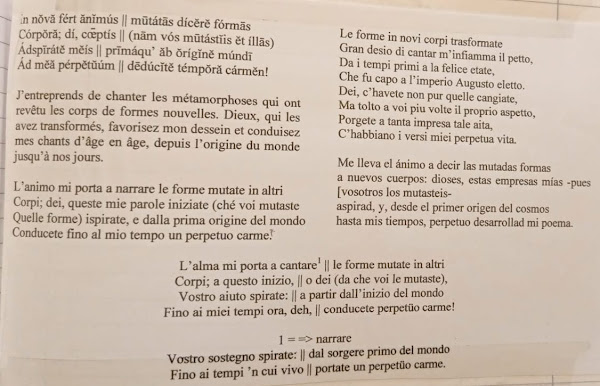
  1. La prima è la traduzione del Proemio delle Metamorfosi di Ovidio, ovvero i versi 1-4 del libro primo di quell'opera; questa è una traduzione che sapevo che esisteva per via di un "index versionum poeticarum" che la menzionava, ma che per qualche ragione si era persa nel quaderno di Letteratura Latina di IV liceo; in effetti su tale quaderno, incollata tra gli appunti dell'1 e del 2/4/2011, si trova questo originale con storia:

    Traduzione di Ovidio come compare sul quaderno di Letteratura Latina

    La traduzione in ottave di endecasillabi si trova qui con tanto di nome dell'autore, le altre sono non metriche quindi non interessano, ma quella centrata in fondo con tanto di cesure è la mia; la collocazione negli appunti indica chiaramente che è stata fatta tra il 1/4 e il 2/4, precisamente tra le relative lezioni, e il fatto che non ve ne sia traccia negli appunti indica che l'ho fatta l'1 dopo scuola, dato che presumibilmente non l'avrei fatta in una lezione diversa da Inglese e Scienze, e nei quaderni di quelle non la si ritrova; sotto riporto due versioni; la storia indica che la prima scritta è quella Originale, e i cambiamenti da questa alla Riveduta sono avvenuti in ordine prima cantare->narrare e poi il rifacimento degli ultimi due versi;
  2. La seconda invece è di un epigramma di Callimaco, precisamente Callimaco 25; ora, questa è greca, ed è spuntata dal quaderno di Catullo perché, non so come, l'avevo trovata come simile ad uno dei carmi visti a scuola, presumibilmente il 72, a cui si attaccava poi anche il 70 sempre come comparandum; suppongo sia balzato fuori dal libro; al tempo comunque l'avevo solo notato, capito, e derubato della parola ταλαίνης, usata poi nella mia canzone in Greco antico; ritrovandomelo davanti nel quaderno ho pensato «Il 70 l'ho tradotto facendo la summa, mo' completiamo l'opera e traduciamo anche Callimaco»; detto fatto: tra le 18:03 e le 18:20 del 14/2/22 l'ho tradotto in distici elegiaci barbari.
Vediamole!


In nova fert animus mutatas dicere formas
Corpora; di, coeptis (nam vos mutastis et illas)
Adspirate meis primaque ab origine mundi
Ad mea perpetuum deducite tempora carmen!


ὤμοσε Καλλίγνωτος Ἰωνίδι μήποτ᾽ ἐκείνης
ἕξειν μήτε φίλον κρέσσονα μήτε φίλην.
ὤμοσεν: ἀλλὰ λέγουσιν ἀληθέα τοὺς ἐν ἔρωτι
ὅρκους μὴ δύνειν οὔατ᾽ ἐς ἀθανάτων.
νῦν δ᾽ ὃ μὲν ἀρσενικῶι θέρεται πυρί: τῆς δὲ ταλαίνης
νύμφης ὡς Μεγαρέων οὐ λόγος οὐδ᾽ ἀριθμός.
L'alma mi porta a cantare || le forme mutate in altri
Corpi; a questo inizio, || o dèi (da che voi le mutaste),
Vostro aiuto spirate: || a partir dall'inizio del mondo
Fino ai miei tempi ora, deh, || conducete perpetüo carme!
L'alma mi porta a narrare || le forme mutate in altri
Corpi; a questo inizio, || o dèi (da che voi le mutaste),
Vostro sostegno spirate: || dal sorgere primo del mondo
Fino ai tempi 'n cui vivo || portate un perpetüo carme!


Ad Ionìde ha giurato Callìgnoto: "Inver io a te
Nessun amico giammai né amica preferirò".
Sì, l'ha giurato; ma dicono il vero: a quei giuramenti
Fatti in amore, non dàn mai attenzione gli dèi.
Ora lui arde d'amor per un uomo, per un uomo, e di lei, poveretta,
Come si fa ai Megarèi, più non fa conto nessun.